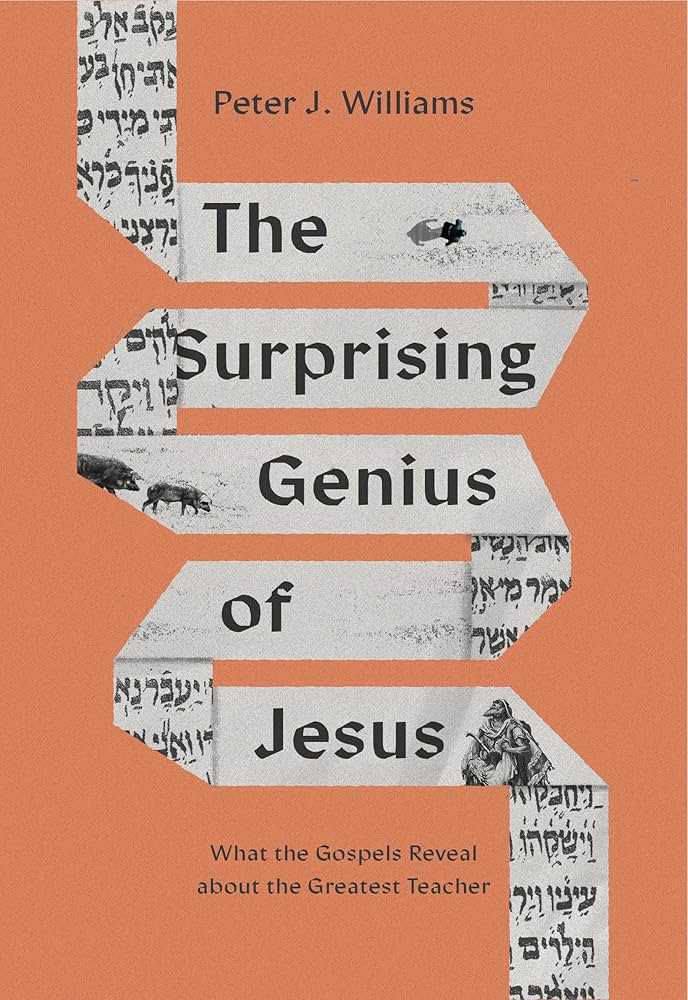

Book Overview
The Surprising Genius of Jesus by Peter J. Williams is a book that sets out to do something quite specific, and does it with a quiet confidence. Rather than offering a broad overview of Jesus’ life or a devotional reflection on his teaching, Williams focuses on the Gospels themselves—particularly how they present Jesus—and asks a simple but often overlooked question: do these accounts actually bear the marks of reliable, eyewitness testimony? And more than that, do they show a level of detail, coherence, and subtlety that suggests careful historical grounding rather than later invention?
The “genius” in the title is not mainly about Jesus as a teacher in the modern sense, though that is certainly part of it. It is more about the way the Gospel accounts themselves display a kind of depth and credibility that is easy to miss on a first reading. Williams draws attention to small details—names, places, cultural references, patterns in the text—that, taken together, build a cumulative case. These are not the sort of things that usually stand out in sermons or Bible studies, but they carry real weight when it comes to questions of trustworthiness.
A key feature of the book is its accessibility. Williams is clearly well-versed in academic scholarship, but he does not write as though trying to impress. The tone is measured, sometimes even understated. He is not combative, and he avoids unnecessary technical language. Instead, he walks the reader through observations that are often simple on the surface but become increasingly compelling as they accumulate.
The book interacts, at points, with common sceptical claims about the Gospels—that they were written too late, that they are full of contradictions, or that they were shaped heavily by later church agendas. But it does not feel like a defensive work. It is more constructive than reactive. Rather than chasing every objection, Williams focuses on showing what is actually there in the text, trusting that careful attention will speak for itself.
There is also a strong sense that the book is written with ordinary Christians in mind. It is not just about answering critics, but about strengthening confidence. Many believers read the Gospels devotionally but may not have considered how historically grounded they are. Williams bridges that gap. He helps readers see that faith in the reliability of Scripture is not a blind leap, but something that rests on solid foundations.
At the same time, the book never loses sight of who Jesus is. While much of the argument revolves around the credibility of the accounts, the end result is not simply a stronger case for the Gospels as historical documents. It is a clearer, more grounded confidence in the person they reveal. The reliability of the message and the identity of Jesus are held closely together.
What did you find most interesting? What did you takeaway from it?
One of the most interesting aspects of the book is how much weight Williams places on small details. In many discussions about the Bible, attention tends to focus on larger themes or apparent problem passages. But here, the argument often turns on things that could easily be overlooked—patterns in names, incidental references to geography, or the way different accounts fit together without obvious coordination.
That approach is surprisingly effective. It creates a kind of cumulative case. No single detail is meant to settle everything on its own, but together they form a picture that is difficult to dismiss. The takeaway is that the Gospels do not read like loosely constructed stories. They have the texture of real accounts, shaped by genuine familiarity with the people and places they describe.
Another striking takeaway is how the book encourages slower reading. It becomes clear that many of the Gospels’ strengths are easy to miss when reading quickly or only for broad application. Williams helps the reader notice things that would otherwise pass by. That has a knock-on effect. It deepens not just confidence in the text, but also appreciation for it. The Gospels begin to feel richer, more carefully constructed, and more grounded in reality.
The book also reinforces the idea that Christianity is rooted in history. That is not a new claim, but it can sometimes feel abstract. Williams makes it more concrete. He shows that the details matter—that names, locations, and cultural context are not incidental, but part of what makes the accounts credible. That strengthens the sense that the gospel is not just a set of ideas, but a message about real events involving real people.
There is also a helpful balance in how the book handles scepticism. It does not dismiss questions or pretend that difficulties do not exist. But it also does not give the impression that everything hangs on resolving every possible issue. Instead, it builds a positive case that makes the overall reliability of the Gospels increasingly plausible.
The main takeaway is a renewed confidence—not just in a general sense, but in a more detailed, grounded way. The reader comes away with a sense that the Gospels can be trusted, not because that is simply assumed, but because there are good reasons for it.
How were you challenged?
This book challenges the tendency to take the Gospels for granted. For many Christians, familiarity can lead to a kind of unexamined confidence. The accounts are read, believed, and valued, but not always closely considered. Williams pushes against that by showing how much there is to notice. That raises the question of whether the Gospels are being read with the kind of attention they deserve.
It also challenges the assumption that questions about reliability are mainly for specialists. The book makes it clear that ordinary readers can engage with these issues in a meaningful way. That can be both encouraging and stretching. It removes the excuse of distance while also inviting deeper thought.
For those who have felt unsettled by sceptical claims, the book offers a different kind of challenge. Rather than responding with anxiety or avoidance, it encourages a more patient, evidence-based approach. It suggests that careful reading and thoughtful consideration can go a long way toward addressing concerns.
There is also a subtle challenge in how the book connects reliability with response. If the Gospels are as trustworthy as Williams argues, then the claims they make about Jesus carry real weight. The question is not just whether the accounts are credible, but what that means for belief and obedience. The historical case leads naturally into a personal question.
Finally, the book challenges the way Scripture is sometimes approached purely for application. While application is vital, the book reminds the reader that understanding the text itself—its context, its details, its structure—is part of faithful reading. That kind of attention is not a distraction from spiritual growth, but a means of strengthening it.
Why should someone else read it?
This book would be especially helpful for Christians who want to feel more confident in the reliability of the Gospels but are not looking for a heavy academic treatment. It provides a clear and accessible way into questions that can otherwise feel intimidating.
It would also be valuable for those who are engaging with sceptical friends or family. The arguments presented are not overly technical, but they are thoughtful and grounded. They offer a way of explaining why the Gospels can be trusted without relying on vague or purely subjective claims.
Church leaders and those involved in teaching would benefit as well. The book provides material that can enrich preaching and Bible study, particularly in helping others see the depth and credibility of the text.
Even for those who already feel confident in the Gospels, the book is worth reading. It deepens that confidence and adds texture to it. It helps move from a general trust to a more informed and considered one.
In the end, The Surprising Genius of Jesus is a reminder that the Gospels reward careful attention. They are not fragile documents that collapse under scrutiny. They hold up, and in many ways, they become more compelling the closer they are examined. That is a valuable encouragement for any church seeking to remain grounded in Scripture.