
Book Overview
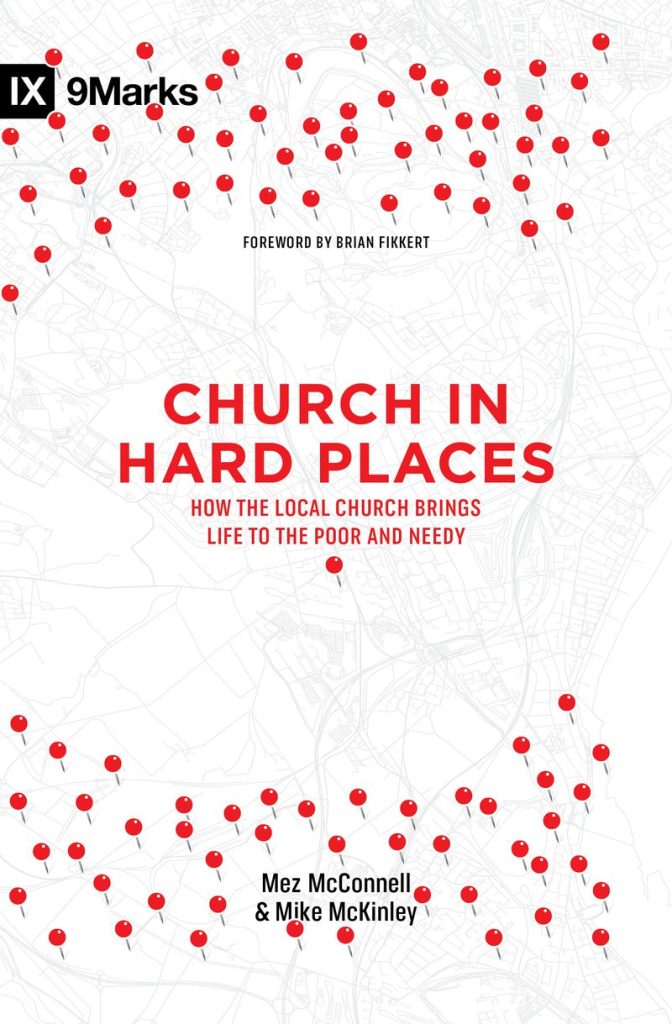
Church in Hard Places by Mez McConnell and Mike McKinley is a book about ministry among the poor and socially disadvantaged, but it is more pointed than that description first suggests. Its central argument is that poverty, in the fullest biblical sense, cannot be addressed merely through projects, charities, or energetic good intentions. The local church has to sit at the centre. That is the burden of the whole book, and it comes through very clearly from the opening chapters onwards. Crossway describes it in exactly those terms: a book arguing that poverty alleviation is doomed to fail if it is detached from the local church, with a strong emphasis on the priority of the gospel and on planting, revitalising, and growing faithful churches in hard places. The structure of the book reflects that concern too, moving from the nature of poverty and the gospel, into ecclesiology, and then into the practical demands of ministry in difficult contexts.
That makes this a very useful book because it refuses to separate compassion from conviction. McConnell and McKinley are not arguing against mercy ministry as such. They are arguing against any approach that quietly sidelines the church, weakens doctrine, or treats evangelism as optional. The table of contents alone shows where the emphasis falls: chapters on doctrine, the parachurch problem, the local church solution, preaching, membership, discipline, and then preparation for the realities of the work. That combination is one of the strengths of the book. It is not simply asking Christians to care more about neglected communities. It is asking whether churches are willing to bring the whole shape of New Testament ministry into places that are often written off, feared, romanticised, or treated as one-dimensional mission fields.
It also helps that the book is written by men who are not speaking from a safe distance. Mez McConnell has served at Niddrie Community Church in Edinburgh and founded 20schemes, while Mike McKinley pastors Sterling Park Baptist Church in Virginia. Their contexts are not identical, but both authors write as pastors with firsthand experience of ministry among the poor. That matters, because the book does not read like a detached policy document. It reads like something shaped by real pastoral bruises, real evangelistic labour, and a real conviction that hard places do not need a diluted Christianity but a stronger, healthier, more faithful church presence.
There is also something refreshing about the fact that the book is not trying to be fashionable. It does engage questions of poverty and justice, but it does so from an unapologetically church-centred and gospel-centred angle. In that sense, it feels very aligned with the best instincts of the 9Marks world it belongs to. It assumes that the ordinary means of grace, clear preaching, meaningful membership, discipline, leadership, and patient discipleship are not luxuries for stable middle-class congregations. They are exactly what is needed in the hardest places as well. That is a needed corrective, because plenty of Christians still assume that difficult settings require a stripped-down, less doctrinal, less churchly version of ministry. This book pushes hard in the other direction.
What did you find most interesting? What did you takeaway from it?
What stands out most is the book’s refusal to let the reader choose between social concern and theological clarity. That tension often drives the whole conversation in evangelical circles. One side wants action and presence, the other wants truth and proclamation, and too often the discussion becomes a tug-of-war. *Church in Hard Places* insists that this is a false choice. The book argues that if people are to be truly helped, then they need more than temporary relief. They need reconciliation to God, transformation by the gospel, and incorporation into a healthy local church. That is not presented as a reason to neglect material need. It is presented as the only way not to reduce people to their visible circumstances.
Another striking feature is the way the book keeps bringing ministry back to the church rather than to specialist organisations. The chapter title “The Parachurch Problem” says a lot by itself. That does not mean the authors deny any useful role for outside ministries. The point is more that Christians can easily drift into outsourcing difficult work, especially in poor communities, and then call that faithfulness. The book presses the reader to see the church not as a support structure running in the background, but as God’s appointed means of displaying the gospel, forming disciples, and creating a new community with a genuinely different way of life. That takeaway lands with some force because it pushes against both activism without ecclesiology and ecclesiology without sacrifice.
There is also a very useful realism running through the book. It does not pretend that hard places can be reached with a few clever methods or a short-term burst of enthusiasm. Even the later chapter titles carry that note: prepare yourself, prepare the work, prepare to change your thinking, count the cost. That is one of the book’s better qualities. It honours the dignity of the people being served by refusing simplistic answers, and it honours the seriousness of ministry by making plain that this kind of work will demand endurance, adjustment, humility, and long obedience.
The wider takeaway is that the church needs a more biblical imagination about where healthy ministry belongs. Hard places are often spoken about as exceptional settings, almost outside the ordinary vision of church life. This book quietly demolishes that assumption. It presents these communities not as side projects for unusually driven Christians, but as places where Christ should be worshipped, where churches should be planted and strengthened, and where biblical Christianity should take root in full. That is probably the book’s most helpful contribution. It widens the reader’s sense of where faithful, ordinary, robust church ministry ought to be found.
How were you challenged?
One of the main challenges in this book is the challenge to comfort. It exposes how easily churches can care about need in ways that still keep real cost at arm’s length. It is possible to speak warmly about the poor, donate generously, support a ministry from afar, and still have no real intention of sharing life with the people being talked about. Church in Hard Places puts pressure on that distance. It forces the question of whether churches actually believe that the hardest, messiest, most neglected communities are worthy of sustained, church-shaped, gospel ministry, not just occasional acts of concern.
It is also challenging because it does not allow weak ecclesiology to hide behind compassionate language. There is a real rebuke here for anyone tempted to think that doctrine, preaching, membership, discipline, and leadership are secondary concerns when ministry gets difficult. The authors argue the opposite. In many ways, those things become even more necessary. That can be uncomfortable because it means the solution to hard places is not simply greater flexibility or looser structures. Often it is deeper convictions, clearer teaching, better shepherding, and more patience than many churches are prepared for.
The book is challenging in another way too. It exposes the subtle pride that can sit underneath some forms of mercy ministry. Christians can enter poor communities assuming they are bringing expertise, stability, or answers, while failing to reckon with their own blindness and need for change. One of the later chapters is explicitly about changing your thinking, and that feels important. Ministry in hard places is not just about transferring resources into deprived communities. It also reshapes the people who go. It exposes class assumptions, naive ministry models, and shallow definitions of success.
There may also be points where some readers would want a little more nuance. Because the book pushes so strongly against parachurch substitutes and thin mercy models, some may feel that certain distinctions could have been drawn out more carefully. Not every non-church ministry is equally problematic, and not every church in a hard place will look the same in practice. But even that critique does not really weaken the book’s value. If anything, its sharpness is part of what makes it useful. It is trying to correct instincts that have been allowed to drift for too long.
Why should someone else read it?
This is a book worth reading because it helps put ministry priorities back in the right order. For pastors, church planters, elders, ministry trainees, and thoughtful church members, it offers something more substantial than general encouragement. It provides a theological framework for understanding poverty and a practical framework for serving in poor communities without losing the centrality of the gospel or the church. That makes it especially useful for anyone wrestling with questions of mercy ministry, urban mission, church planting, revitalisation, or ministry among the socially marginalised.
It is also worth reading because it speaks into a real blind spot in many conservative evangelical settings. Plenty of churches are strong on doctrine and weak on proximity. Others are strong on compassion and weak on ecclesiology. This book speaks to both problems at once. It calls churches to go nearer, stay longer, and love more concretely, while also insisting that the answer is not to tone down the very truths that make the church the church. That combination is not common, and it is badly needed.
For churches in ordinary suburban settings, this book is still valuable even if the local context feels very different from Niddrie or Sterling Park. The lessons carry beyond one kind of neighbourhood. The bigger issue is whether Christians really believe the local church is God’s primary means of making disciples and displaying the gospel among every kind of people, including those often neglected by mainstream evangelical life. On that point, the book has something important to say to almost everyone.
More than anything, it is a book that can help correct sentimentality. It gives a vision for ministry that is compassionate without being soft, doctrinal without being detached, and practical without becoming merely pragmatic. That is a hard balance to strike. Church in Hard Places does it well enough to make it a book that should be read, discussed, and put to work in churches that want to think more seriously about faithful ministry in difficult contexts.